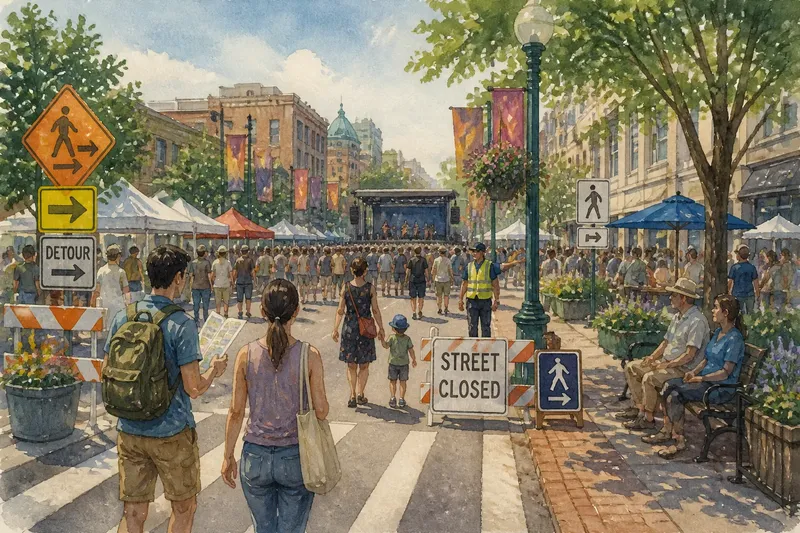
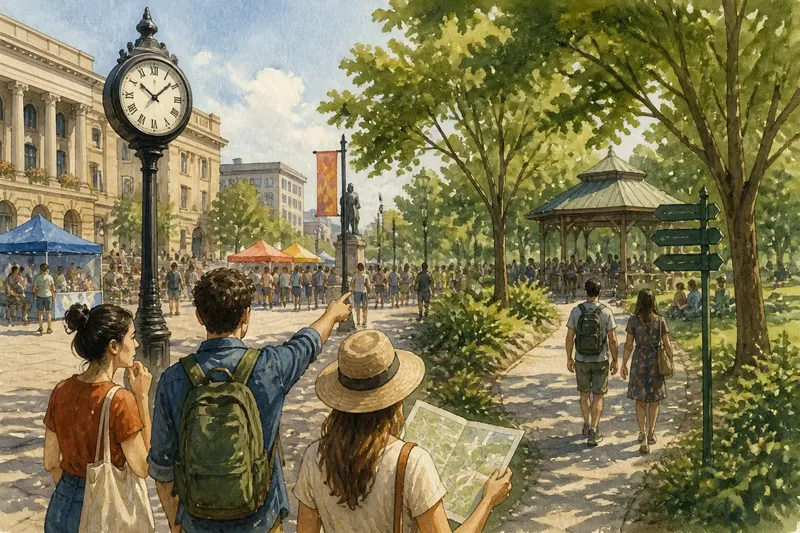
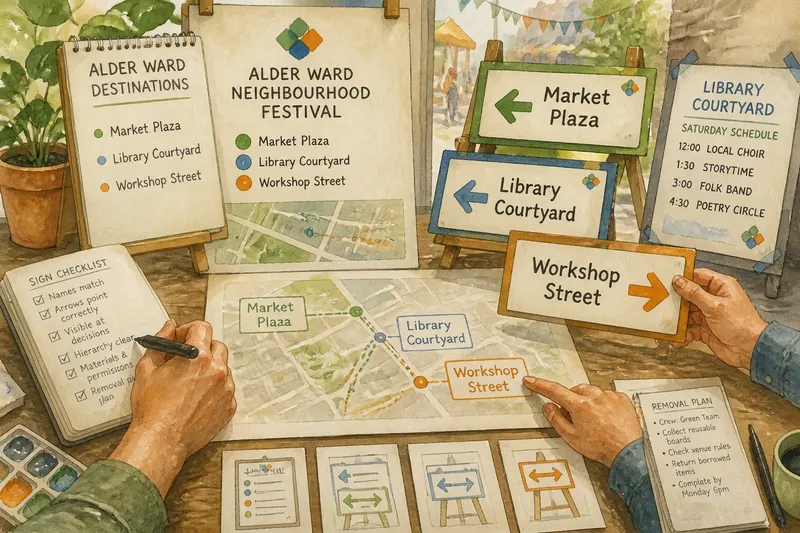
A City Walk After the Festival Has Left
A city walk after the festival reveals what the gathering left behind and how streets and squares are returning to everyday use, without confusing traces with causes.
The common mistake on a city walk after the festival is treating every mark as proof that the event changed the neighborhood. A city walk after the festival is more useful when you record what remains and notice how people are using the site now, without turning each trace into a story about its cause.
Choose a street, square, or park that hosted the gathering and make a short loop through its center, edges, and approaches. The aim is to see how a temporary city-making effort has receded into everyday life: what has been cleared, what still shapes movement, and what public routines have resumed.
Choose a festival route
Include a likely entrance, a gathering area, a nearby transit stop, and a route people used to leave. This gives the walk a beginning, middle, and edge, where the festival’s design may have met ordinary streets and daily errands.
Use a pocket notebook or your phone’s notes app. Write locations precisely, such as “north entrance, beside the bike rack,” so a detail can be found again without relying on memory or an unclear photo.
Record what remains
Notice marks on paving, compressed grass, empty sign clips, cable covers, and temporary attachments. Also look at the less visible parts of the festival’s afterlife: a bench back in use, a crossing people have resumed, or an open corner that still feels like a natural meeting point.
- Surface condition: Check whether tape, chalk, scuffs, or flattened grass is visible; if it forms a clear line or patch, note its location, and if it is isolated, record it without connecting it to the festival.
- Temporary fixtures: Check for cable covers, clips, brackets, or barrier feet; if one remains, note whether it blocks ordinary use, and if none remains, move on to the next part of the route.
- Foot movement: Check whether people detour around a spot or cross it directly; if a detour persists, describe the route people take, and if movement is direct, note that the space is being used normally now.
- Public furniture: Check whether benches, steps, and open corners are occupied; if they are in use, record the activity, and if they are empty, continue without treating vacancy as evidence of a lasting change.
- Cleanup activity: Check for workers, collected materials, or temporary barriers; if work is active, describe the site as still being cleared, and if it is not, record only the condition visible on this visit.
- Access and safety: Check whether a remnant obstructs a path or creates uncertainty for people passing through; if it does, note the obstruction and avoid disturbing it, and if it does not, record it as visible but not disruptive.
Connect traces to place
A strip of adhesive on paving is an observable trace; its purpose is a separate question. Its position beside a curb cut, doorway, crossing, or cluster of public furniture may help you understand how the event used the site, but the walk alone cannot establish why the strip is there.
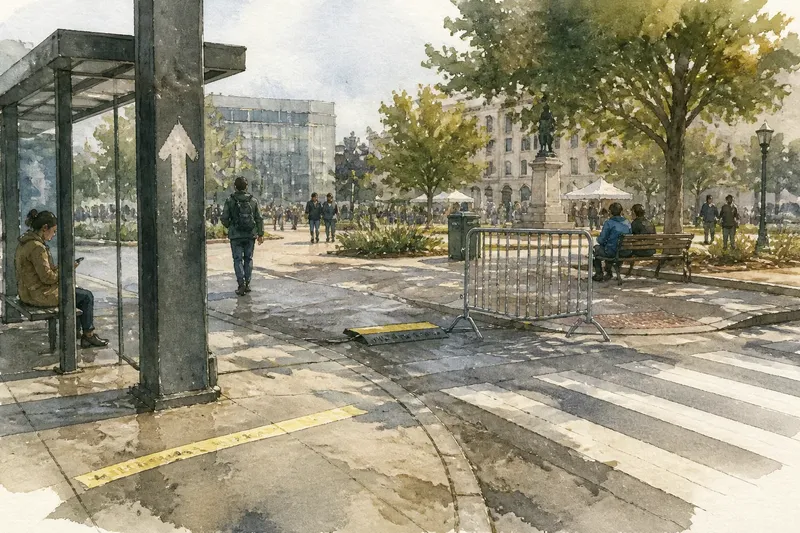
Keep the description and interpretation apart in your notes. Write “faded arrow on the pole beside the bus shelter” first; if you have a possible explanation, add it separately as a possibility rather than folding it into the observation.
What can a post-festival walk tell you?
How can I distinguish event traces from ordinary wear?
Compare a mark with nearby surfaces and note whether it follows an obvious event feature, such as a temporary entrance or loading area. If the pattern is unclear, record the mark and location without assigning a cause.
What if cleanup is still underway?
Note the active work and treat the site as being in transition, rather than as its settled post-event condition. If you return later, you can describe what is visible then without assuming that the change came only from cleanup.
Should I photograph leftover objects?
A photo can preserve a placement or surface detail; include a nearby landmark so you can identify the spot later. Avoid close images of people, and do not enter restricted areas or move equipment to get a clearer view.
How can I describe a change that may last?
Record what is present on this visit and, if useful, return at a comparable time to see what is visible then. A later walk can add another observation, but it cannot by itself establish what caused a change or how long it will remain.
Walk one site closely
Say you arrive at a square with a pale strip of tape near a bus shelter, a cable cover by the main path, and a temporary barrier beside a curb cut. First, write those three locations down; then watch whether people step around the tape, cross the cable cover, or detour at the barrier.
If people pass the tape without changing course, record it as a visible remnant with no obvious effect on movement. If they detour around the barrier, describe the detour and the blocked curb cut; the resulting note captures how the square works now, while leaving the origins of each item unresolved.
Keep the visit focused
Finish by noting what has been removed, what remains visible, and how the space is being used during the walk. That gives a grounded account of the festival’s passage through the city without turning a few leftovers into a verdict on the event or the neighborhood.
A city walk after the festival is most useful when its record stays tied to particular places: a crossing, a bench, a shelter, or the edge of a square. Those details make the next visit easier to compare and keep everyday public life—not just the event’s remnants—in view.